Most energy efficient space heater: 3 oil-filled picks
Which space heater uses the least electricity? How to work out real kWh, why oil-filled radiators suit long hours, and three picks with digital thermostats and ECO mode.
In this article
- The three energy efficient heaters we recommend
- Dreo DR-HSH010: the best all-rounder for living rooms and home offices
- PELONIS PSHO06MR6ASB: the quietest pick for bedrooms
- hykolity ZOH701E: the budget pick with a real on/off timer
- Which space heater uses the least electricity, by type
- Digital thermostat, ECO mode and timer: what each one does
- How big a heater does your room need
- Mistakes that push your bill up
- When it's worth buying, and when it isn't
- Our verdict
- Sources and criteria for this guide
The most energy efficient space heater is the one that spends the fewest hours at full power, and for a room you heat every evening our pick is the Dreo DR-HSH010 oil-filled radiator: a digital thermostat you set one degree at a time, three power levels (600, 900 and 1500 W) and an ECO mode that steps the wattage down on its own as the room nears your setting. Your electric bill counts kilowatt-hours, which is watts multiplied by hours, and a precise thermostat plus a timer cut into both numbers.
- For living rooms and long hours Dreo DR-HSH010 Oil Filled Radiator Heater, 1500W, Digital Thermostat, ECO, Remote Premium See on Amazon
- For bedrooms and light sleepers PELONIS Oil Filled Radiator Heater with Remote, ECO Mode, 24H Timer, 1500W Budget pick See on Amazon
- For tight budgets hykolity ZOH701E Oil Filled Radiator Heater, 1500W, ECO, 24H On/Off Timer Budget pick See on Amazon
The three energy efficient heaters we recommend
We looked for heaters that help you use less electricity with real tools: an electronic thermostat, several power levels, a timer and a remote. All three are oil-filled radiators, because that design fits long hours in one room better than anything else that plugs into a wall. If you want quick blasts of heat instead, our guide to the best space heater for bedrooms, bathrooms and offices covers ceramic models.
Dreo DR-HSH010: the best all-rounder for living rooms and home offices
 Illustrative image
- Digital thermostat, 41–95°F
- Three levels (600/900/1500 W) plus ECO mode
- Remote, 24-hour timer, child lock, tip-over protection
| Type | Oil-filled radiator, 7 fins |
|---|---|
| Power | 1500 W, 120 V |
| Power levels | 3 (600/900/1500 W) + ECO |
| Coverage | Up to 250 sq ft |
| Temperature range | 41–95°F |
| Timer | 24 hours |
The Dreo is a 1500 W, 120 V oil-filled radiator with seven fins, a large LED display, a touch panel and a remote. Where it pulls ahead of a dial-controlled radiator is control: you set the temperature between 41 and 95°F, and in ECO mode the heater picks its own power level from the room reading, so a nearly warm room gets 600 or 900 W instead of a steady 1500. Dreo rates it for rooms up to about 250 square feet.
It has a 24-hour timer, a child lock, mute and screen-off modes for the bedroom, tip-over protection and triple overheat protection, and it is ETL listed. Large casters and handles make it easy to roll from room to room.
- Digital thermostat and an ECO mode that modulates power automatically.
- Three levels: at 600 W it draws well under half the power of the top setting.
- Remote with batteries included, 24-hour timer, mute and screen-off.
- Like every oil-filled heater, it is slow to warm a cold room; plan ahead and let the timer start it.
- No Wi-Fi or app, so scheduling is by countdown only.
- The priciest of the three.
Who it's for: anyone heating a living room, den or home office for hours at a stretch who wants the heater to manage its own wattage.
PELONIS PSHO06MR6ASB: the quietest pick for bedrooms
 Illustrative image
- Fanless, near-silent heating
- Thermostat 41–95°F in 1°F steps
- Three levels plus ECO, remote and 24-hour timer
| Type | Oil-filled radiator |
|---|---|
| Power | 1500 W, 120 V |
| Power levels | 3 (600/900/1500 W) + ECO |
| Coverage | Up to 280 sq ft |
| Temperature range | 41–95°F, 1°F steps |
| Timer | 24 hours |
The PELONIS is another 1500 W oil-filled radiator with three levels (600, 900 and 1500 W), an ECO mode, a 24-hour timer, a remote and an LED touchscreen. Its thermostat runs from 41 to 95°F in 1°F steps, and since there is no fan, PELONIS markets it as close to silent. The company rates it for rooms up to about 280 square feet.
- Fanless design: you hear the thermostat click and little else.
- Fine 1°F thermostat steps and ECO mode.
- Casters and handles for moving it between rooms.
- Slow warm-up, as with any oil-filled heater.
- Heavy and bulky like any oil-filled radiator; on stairs you carry it rather than roll it.
- No app or smart-home control.
Who it's for: light sleepers who want steady warmth in a bedroom or nursery without fan noise.
hykolity ZOH701E: the budget pick with a real on/off timer
 Illustrative image
- Programmable 24-hour on/off timer
- Settings memory after power loss
- Three levels plus ECO, child lock, mute
| Type | Oil-filled radiator, 7 fins |
|---|---|
| Power | 1500 W, 120 V |
| Power levels | 3 (600/900/1500 W) + ECO |
| Coverage | Bedrooms to living rooms |
| Temperature range | 50–95°F |
| Timer | 24-hour on/off |
The hykolity covers the same basics for less: 1500 W, seven fins, three levels (600, 900 and 1500 W), ECO mode and a thermostat from 50 to 95°F. Two details set it apart. The 24-hour timer can be programmed to switch the heater on as well as off, and a memory function keeps your settings after a power outage. Child lock, mute and screen-off modes are included.
- Programmable on/off timer, handy for a pre-warmed room in the morning.
- Settings survive a power cut.
- The lowest price tier of the three.
- The remote needs two AAA batteries, which are not in the box.
- Thermostat starts at 50°F, so there is no true low frost-guard setting.
- No app or smart-home control.
Who it's for: anyone on a tight budget who still wants digital controls and a timer that can start the heater before they wake up.
| Dreo DR-HSH010 Oil Filled Radiator Heater, 1500W, Digital Thermostat, ECO, Remote | PELONIS Oil Filled Radiator Heater with Remote, ECO Mode, 24H Timer, 1500W | hykolity ZOH701E Oil Filled Radiator Heater, 1500W, ECO, 24H On/Off Timer | |
|---|---|---|---|
| Best for | For living rooms and long hours | For bedrooms and light sleepers | For tight budgets |
| Type | Oil-filled radiator, 7 fins | Oil-filled radiator | Oil-filled radiator, 7 fins |
| Power | 1500 W, 120 V | 1500 W, 120 V | 1500 W, 120 V |
| Power levels | 3 (600/900/1500 W) + ECO | 3 (600/900/1500 W) + ECO | 3 (600/900/1500 W) + ECO |
| Coverage | Up to 250 sq ft | Up to 280 sq ft | Bedrooms to living rooms |
| Temperature range | 41–95°F | 41–95°F, 1°F steps | 50–95°F |
| Timer | 24 hours | 24 hours | 24-hour on/off |
| Connectivity | Remote control | Remote control | Remote (2 AAA not included) |
| Price band | Premium | Budget pick | Budget pick |
| See on Amazon | See on Amazon | See on Amazon |
Which space heater uses the least electricity, by type
Start with the physics, because it clears away a lot of box-copy promises. Every electric space heater turns all the electricity it draws into heat. An oil-filled radiator, a ceramic heater and an infrared heater rated at 1500 W all use 1.5 kWh in an hour at full power. What differs is how the heat reaches you and the room, and therefore how long the heater needs to run flat out.
Oil-filled radiators. The oil stores heat and keeps releasing it after the thermostat cuts out, so room temperature swings less and the heater cycles on less often. This is the type that suits long hours.
Ceramic fan heaters. Fast and portable, they warm the person in front of them in minutes, and the warmth disappears almost as soon as they stop. For a short session at a desk or in a bathroom, they make sense. For heating a whole room all evening, we think they are the weakest choice.
Infrared heaters. They warm objects and people in their line of sight rather than the air. They work for a garage workbench or a drafty spot, less so for evenly heating a closed room.
Digital thermostat, ECO mode and timer: what each one does
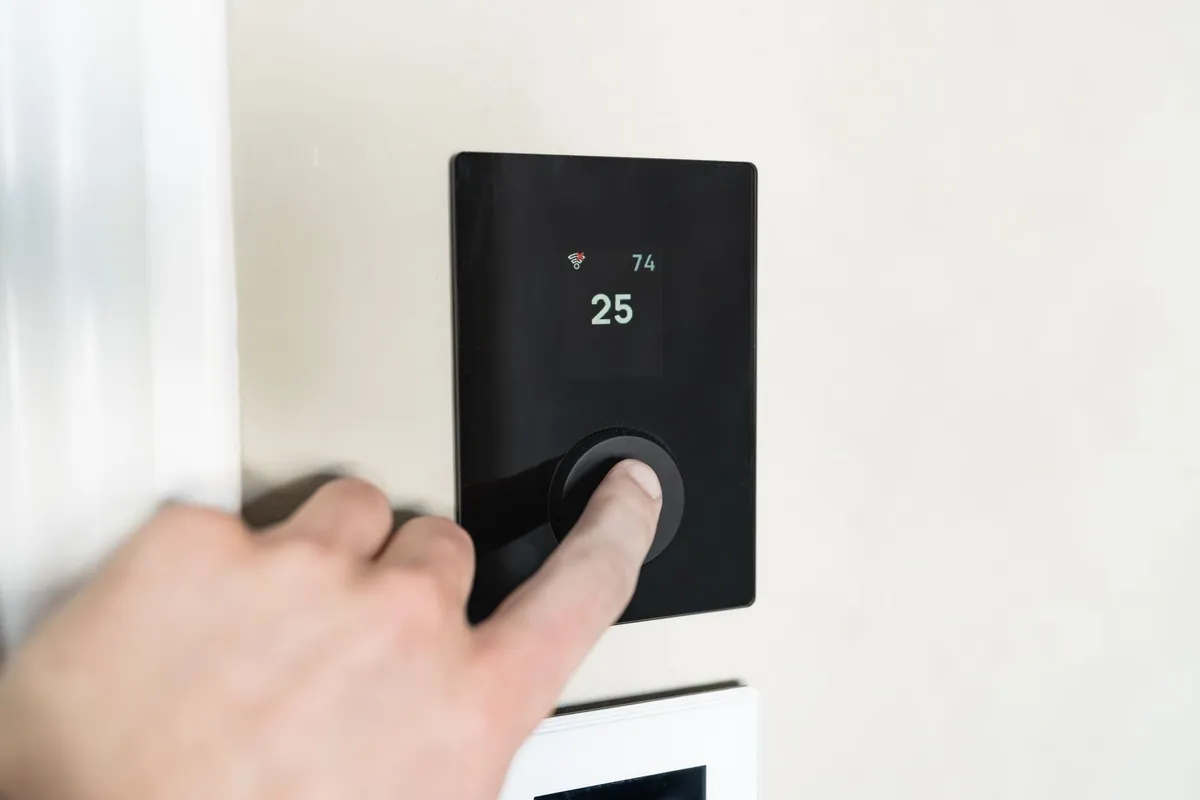
A dial thermostat without numbers works by feel: you turn it until the room seems warm, and most people end up setting it higher than they need. A digital thermostat lets you pick 68°F and leave it there. That is the first and cheapest way to save, which is why all three heaters here have one.
ECO mode is the second. On these models it lowers the power level as the room approaches your setting, so the heater spends less time at 1500 W.
The timer is the most underrated feature. A countdown timer stops the heater from running all night after you fall asleep; an on/off timer like the hykolity's lets the room warm up shortly before you need it. If your utility offers time-of-use rates, the timer also lets you shift heating into cheaper off-peak hours.
How big a heater does your room need
Almost every plug-in heater in the US tops out at 1500 W, because that is about what a standard 15-amp household circuit can safely carry alongside other loads. So the real question is less about wattage and more about whether the room is small, closed and reasonably insulated. Dreo and PELONIS rate their heaters for roughly 250 and 280 square feet; in an older home with drafty windows, treat those numbers as optimistic.
Plug the heater straight into a wall outlet. Heater makers warn against extension cords and power strips, and a 1500 W heater sharing a circuit with a microwave or a hair dryer can trip the breaker.
Mistakes that push your bill up
- Cranking the thermostat to the max "to heat faster". The room does not warm faster; the heater just runs longer afterward.
- Trying to heat the whole house. A space heater pays off in the room you are in, with the door closed and the central thermostat turned down.
- Drying laundry on the fins. Besides the safety risk, it traps heat and confuses the thermostat.
- Ignoring dry air. Heated winter air dries out; if you feel it in your throat, our guide on which humidifier to buy for a bedroom will help more than nudging the temperature up.
And if the cold that bothers you is in bed, heating the bedroom all night is the expensive fix; see which heated mattress pad to buy for an option that runs on a small fraction of the wattage.
When it's worth buying, and when it isn't
It's worth it if you need to heat one or two rooms a few hours a day, if you work from a chilly home office, or if you want to keep the central thermostat lower at night. Skip it if you plan to heat a whole apartment with plug-in heaters: for that many hours, a heat pump or a mini-split uses far less electricity for the same warmth. If you're timing your purchase around late-November sales, our page on what to expect on Black Friday explains how to spot a genuine discount.
Our verdict
For living rooms and long hours: Dreo DR-HSH010, because its thermostat, three levels and ECO mode keep full-power time to a minimum.
For bedrooms and light sleepers: PELONIS PSHO06MR6ASB, fanless with fine 1°F steps.
For tight budgets and early risers: hykolity ZOH701E, with an on/off timer and settings memory.
View on Amazon.com Paid link
Sources and criteria for this guide
We compared the spec sheets and manuals from Dreo, PELONIS and hykolity, the room sizes each maker states, and buyer reviews written after a full winter of use, to see which flaws show up over time. Only heaters with an electronic thermostat, at least three power levels, a timer, overheat and tip-over protection, sold on Amazon.com for 120 V outlets, made the list. We left out models with vague wattage claims and those promising percentage savings without explaining how they were measured.
Frequently asked questions
What is the most energy efficient space heater?
How much electricity does a 1500W space heater use per hour?
Are oil-filled radiators cheaper to run than ceramic heaters?
Is it safe to leave an oil-filled heater on overnight?
Does ECO mode on a space heater really save money?
As an Amazon Associate I earn from qualifying purchases.

Emily Carter
Editorial byline of the English edition for home, kitchen and beauty. Angle: what verified reviews say happens after a month of use, and the cheap products that surprise.
Guide produced by the editorial team with AI tools from verified sources and published under the editorial responsibility of Andrea Bertolotti. How we work · Report an error
You may also like
Space heater: which one to buy for a bedroom, bathroom or office
Ceramic heater, bathroom model or oil-filled radiator: four space heaters for bedrooms, bathrooms and living rooms, and how to keep the electric bill in check.

Air fryer price comparison: what you get at each price tier
How much to spend on an air fryer: what you actually gain moving from a budget model to midrange and premium, with one recommended pick in each tier.
How much electricity does an air fryer use? 3 efficient picks
How much electricity an air fryer uses, how to do the kWh math with your own rate, and three models that keep energy use low, from singles to big families.
The best guides, once a week
No spam: only products worth knowing about and deals that make sense.