Air fryer buying guide: what size, what watts and which to buy
How to choose an air fryer for a U.S. kitchen: quarts per household, watts, top temperature and three models compared, from a 6-quart basket to a dual-zone 8-quart.
In this article
- How we chose
- The three models
- Cosori TurboBlaze 6-quart: the one to start with
- Ninja DZ201 DualZone 8-quart: for people who cook for everyone
- Cosori 6.5-quart with clear window: for people who want to see
- How many quarts you need: the table by household size
- Watts, degrees and presets: what actually counts
- Energy and counter space compared with the oven
- First-week mistakes and cleaning
- When it makes sense and when to skip it
- Our verdict
- Frequently asked questions
- Does an air fryer replace the oven
- How much oil do you really need?
- What should I look for when choosing an air fryer
- Is the basket ruined in the dishwasher?
- Parchment and foil in the air fryer
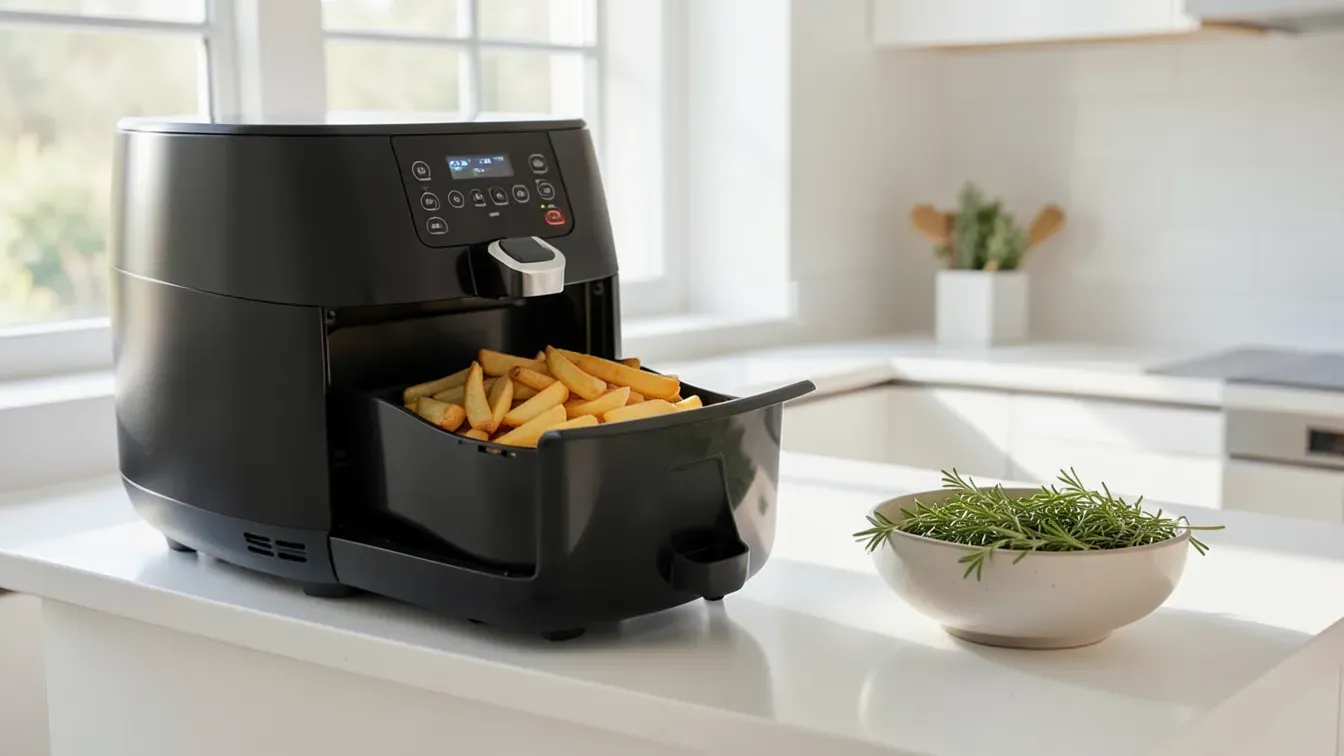
The air fryer we recommend to a family of three or four is the Cosori TurboBlaze 6-quart: a single basket, 1725 watts and a stated top temperature of 450°F that handles a full tray of fries in one batch. The number that decides the purchase is not the watts but the quarts: usable capacity is about half the stated volume, and below you will find how many quarts you need for how many people.
- Editors' pick Cosori TurboBlaze 6-Quart Air Fryer Budget pick See on Amazon
- Dual basket Ninja DZ201 Foodi DualZone 8-Quart Air Fryer Premium See on Amazon
- Clear window Cosori 6.5-Quart Clear Window Air Fryer Budget pick See on Amazon
How we chose
We do not test appliances ourselves. We work from the manufacturers' spec sheets and manuals, from published tests by the specialist press and from verified reviews by people who have used the fryer for at least six months. Four things carry weight: usable capacity, wattage relative to size, top temperature and how easy it is to clean. The number of presets does not count, because after the first weeks almost nobody uses them.
The three models
Cosori TurboBlaze 6-quart: the one to start with
A square 6-quart basket that uses space better than round ones, 1725 watts, a five-speed fan and a stated range up to 450°F. The shake reminder halfway through avoids raw fries in the middle, the touch panel is clear and the basket slides out with one hand. It has no window and it is not silent. In reviews past the one-year mark the most frequent note concerns the ceramic nonstick coating, which needs gentle care.
 Illustrative image
- 6-quart square basket, wide and deep rather than round
- 1,725 W with a 90–450 °F range and five fan speeds
- PFAS-free ceramic coating on basket and crisper plate
- Preheat you can switch on or skip, 9 cooking functions
- Rated by COSORI at under 53 dB even at the highest fan speed
| Capacity | 6 qt |
|---|---|
| Power | 1725 W |
| Temperature range | 90-450 °F |
| Presets | 9 |
| Dimensions | about 12 × 12 in footprint |
| Dishwasher safe | yes (basket and plate) |
- Square 6-quart basket: three or four portions in one batch
- Stated top temperature of 450°F and a five-speed fan
- Basket and plate are dishwasher safe
- Clear touch controls, basket slides out with one hand
- No window: to check, you open it
- The fan is audible in an open-plan kitchen
- The coating dislikes abrasive sponges and heavy dishwasher cycles
Ninja DZ201 DualZone 8-quart: for people who cook for everyone
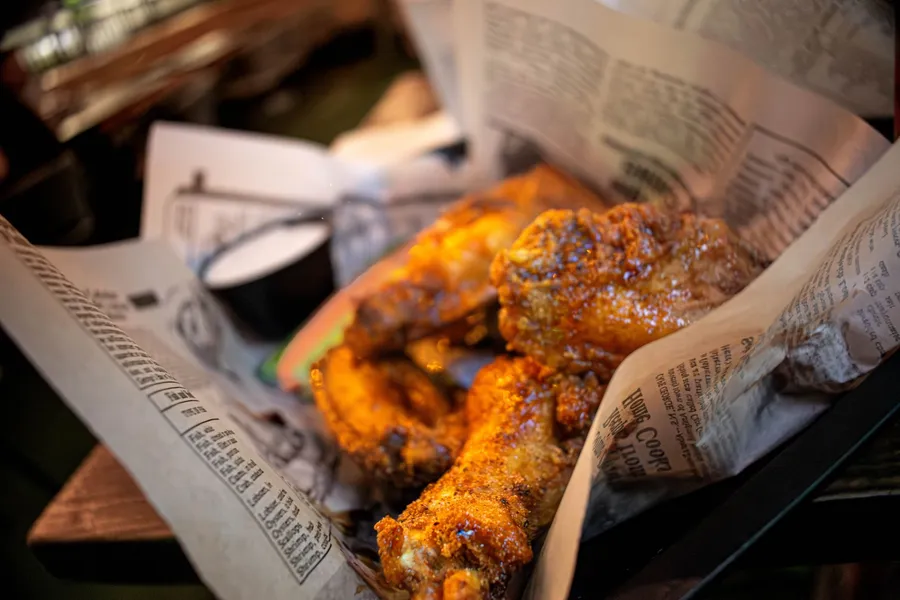
Two independent 4-quart baskets with their own heater and fan: chicken at 400°F on one side, vegetables at 350°F on the other, and with Smart Finish they are done at the same moment. It is the only one here that truly replaces the oven on a family weeknight. It takes almost 16 inches of counter, but Max Crisp at 450°F and 1690 watts make it the fastest on frozen food.
 Illustrative image
- Two independent 4-quart zones, each with its own fan and heater
- Smart Finish lands two foods at once, Match Cook copies settings
- 1,690 W and a 105–450 °F range for dehydrating or crisping
- Six functions: air fry, air broil, roast, bake, reheat, dehydrate
- Ninja quotes up to 4 lb of fries or wings in one load
| Capacity | 8 qt (2 × 4 qt) |
|---|---|
| Power | 1690 W |
| Temperature range | 105-450 °F |
| Presets | 6 |
| Dimensions | about 16 × 14 in footprint |
| Dishwasher safe | yes (baskets and plates) |
- Two independent baskets: two dishes together, ready at the same time
- Max Crisp at 450°F for frozen food
- Match Cook copies settings across both baskets
- Baskets and crisper plates are dishwasher safe
- Almost 16 inches wide: it does not fit under low cabinets
- The perforated plates are the tedious part to clean
- Costs about twice the Cosori
Cosori 6.5-quart with clear window: for people who want to see
The lit window looks like a gimmick until you use it: you check browning without pulling the basket, so without dropping the temperature. Underneath there are 6.5 quarts for four or five people, twelve one-touch functions and a nonstick basket that goes in the dishwasher. Twelve functions are more than you will use, but the savable custom settings are handy once you know your two favorite recipes.
 Illustrative image
- Lit viewing window: check browning without pulling the basket
- 6.5 quarts in an 11.8-inch-wide body, 1,700 W at 120 V
- 170–400 °F range with twelve one-touch functions
- Savable custom presets and a shake reminder
- Nonstick basket and crisper plate, both dishwasher safe
| Capacity | 6.5 qt |
|---|---|
| Power | 1,700 W |
| Temperature range | 170–400 °F |
| Presets | 12 |
| Dimensions | 14.6 x 11.8 x 12.6 in |
| Dishwasher safe | yes (basket) |
- Clear window with interior light: check without opening
- 6.5 quarts, enough for four or five people
- Savable custom cooking functions
- Dishwasher-safe basket
- Larger footprint than the 6-quart TurboBlaze
- Twelve functions of which you will use three
- The window needs wiping after greasy food
If the gap under your wall cabinets matters more than the basket size, we measured the models that stay under thirteen inches in our low profile air fryer guide.
Already set on the Dutch brand but lost in the model codes? We lined up the Philips Airfryer range, from the compact 2000 Series to the Dual Basket, with the right pick for each household.
Before you settle on a capacity, measure your counter: our guide to air fryer dimensions has a footprint table and the clearance you need for steam and the drawer.
If you want to cook on two racks at once or spin a whole chicken on a rotisserie, a basket won't do it: that's when an air fryer oven, with a door and racks, makes more sense.
| Cosori TurboBlaze 6-Quart Air Fryer | Ninja DZ201 Foodi DualZone 8-Quart Air Fryer | Cosori 6.5-Quart Clear Window Air Fryer | |
|---|---|---|---|
| Best for | Editors' pick | Dual basket | Clear window |
| Capacity | 6 qt | 8 qt (2 × 4 qt) | 6.5 qt |
| Power | 1725 W | 1690 W | 1,700 W |
| Temperature range | 90-450 °F | 105-450 °F | 170–400 °F |
| Presets | 9 | 6 | 12 |
| Dimensions | about 12 × 12 in footprint | about 16 × 14 in footprint | 14.6 x 11.8 x 12.6 in |
| Dishwasher safe | yes (basket and plate) | yes (baskets and plates) | yes (basket) |
| Max temperature | – | – | 450 °F |
| Viewing window | – | – | yes, with interior light |
| Price band | Budget pick | Premium | Budget pick |
| See on Amazon | See on Amazon | See on Amazon |
How many quarts you need: the table by household size
Capacity is the number that matters most, and almost everyone undersizes it. Stated quarts measure the basket, not the food it holds: to cook well you must leave air between the pieces, so usable capacity is about half. With 4 quarts you cook about 1.3 pounds of fries in one batch, two portions. With 6 quarts you reach three or four. With 8 quarts split into two baskets you handle a full meal.
| People at the table | Recommended capacity | What fits in one batch | Model in this guide |
|---|---|---|---|
| 1-2 | 2-4 qt | Two portions of fries, four chicken thighs | See our compact air fryer guide |
| 2-4 | 5-6.5 qt | Two pounds of fries, a 3-pound chicken | Cosori TurboBlaze 6 qt, Cosori 6.5 qt window |
| 4-6 | 8-10 qt, ideally dual basket | Main and side together | Ninja DZ201 8 qt |
Below 4 quarts the reasoning changes: the free inch of counter decides, not the number of mouths. If there are two of you at home, we compared three models from 2 to 4 quarts in our guide to the compact air fryer.
Watts, degrees and presets: what actually counts
Between 1400 and 1700 watts the difference is hard to feel on a 4-to-5-quart basket. Above 6 quarts you want at least 1700 watts, or preheating stretches and big batches cook unevenly. Top temperature is the second detail: many models stop at 400°F, which is enough for fries, chicken and vegetables. All three here reach 450°F, and on frozen food those extra degrees show. Presets help the first weeks; what you keep using is automatic preheat and the shake reminder. One detail the spec sheets skip is noise: all three run like a range hood on medium, fine in a kitchen and annoying in a studio during a movie. Verified reviews name the Ninja as the loudest when both zones run together.
Energy and counter space compared with the oven
A full-size electric oven draws 2000 to 3000 watts on a 240 V circuit and needs 10 to 15 minutes just to reach 400°F. An air fryer on a standard 120 V outlet is ready in three minutes and cooks the same fries in 20 minutes instead of 35 to 40: on a typical cook it uses roughly half the energy, and at the national average of about 17 cents per kWh reported by the U.S. Energy Information Administration the saving per meal is small but real. On the counter a 6-quart model takes about 12 by 12 inches and wants 4 inches of clearance behind for venting; dual-basket units exceed 16 inches in width and do not fit under low cabinets. If the kitchen is already crowded by a robot vacuum dock and a coffee maker, measure first.
First-week mistakes and cleaning
Filling the basket to the brim is mistake number one: air has to pass between the pieces, and half a basket cooks better than a full one. Then skipping preheat, not shaking halfway, using aerosol cooking spray that ruins the coating, and parking it under the cabinet where steam damages the wood. Cleaning is short: basket and plate soak in hot soapy water for ten minutes, soft sponge, dry completely. Dust the heating element every two weeks with a damp cloth, unit cold and unplugged. The dishwasher is allowed on all three, but heavy cycles wear the coating faster. The steam from every cook adds to kitchen humidity: if the windows fog in winter, our guide to the home dehumidifier explains what size you need.
When it makes sense and when to skip it
It makes sense if you cook for two or more people most evenings and turn on the oven mainly for fries, chicken and vegetables. Skip it if you already have a convection oven and use it for sheet pans of lasagna and pizza: the rectangular cavity has no substitute. Skip the dual basket if there are two of you, because it wastes space and costs nearly twice as much. And skip anything under 5 quarts for a family: it forces two batches and the first arrives lukewarm.
Our verdict
Family of three or four: Cosori TurboBlaze 6-quart. Big enough, fast, with a square basket that uses the space.
Four or more at the table, every day: Ninja DZ201 DualZone 8-quart, the only one that replaces the oven on weeknights.
Delicate food and browning control: Cosori 6.5-quart with the clear window.
See it on Amazon.com Paid link
Frequently asked questions
Does an air fryer replace the oven
For portions of one to four people, almost always: it heats in two or three minutes and cooks faster. For a pan of lasagna or a 5-pound chicken the oven remains easier.
How much oil do you really need?
For fresh potatoes, vegetables and meat, one or two teaspoons brushed or misted. Pre-fried frozen food needs none.
What should I look for when choosing an air fryer
Usable capacity for your household, at least 1700 watts above 6 quarts, a top temperature of 450°F for frozen food, and dishwasher-safe parts. A window is a comfort, not a requirement.
Is the basket ruined in the dishwasher?
The baskets of all three models are declared dishwasher safe. The coating lasts longer washed by hand with a soft sponge, but it is not mandatory.
Parchment and foil in the air fryer
Yes, as long as they sit under the food and do not cover the whole floor: air has to circulate. Perforated liners made for air fryers are best.
Frequently asked questions
Does an air fryer replace the oven?
How much oil do you really need?
What should I look for when choosing an air fryer?
Is the basket ruined in the dishwasher?
Can I use parchment or foil?
As an Amazon Associate I earn from qualifying purchases.

Emily Carter
Editorial byline of the English edition for home, kitchen and beauty. Angle: what verified reviews say happens after a month of use, and the cheap products that surprise.
Guide produced by the editorial team with AI tools from verified sources and published under the editorial responsibility of Andrea Bertolotti. How we work · Report an error
You may also like
Small air fryer for one or two people: 3 compact picks
From 2 to 4 quarts: the real counter footprint, which models clear a low cabinet and how much food actually fits in a single layer.
Air fryer oven vs basket: which air fryer oven to buy
Air fryer ovens with a door, racks and a rotisserie: when they beat a basket air fryer, how much counter they take and four picks by kitchen and budget.

Which Philips Airfryer to buy: compact, XL, XXL or Dual Basket
Which Philips Airfryer to buy: the 3000 Series XL for families, the 2000 Series with a window for two, the Dual Basket and the Premium XXL, plus how to read model codes.
The best guides, once a week
No spam: only products worth knowing about and deals that make sense.