Robot vacuums worth buying: four models and what matters
Four robot vacuums compared, from a dockless budget model to a hot-water washing flagship: height, pet hair, spare parts and how much work they actually save.
In this article
- How we chose
- The robot that just vacuums, no dock attached
- Does a self-emptying base actually change anything?
- Mopping: dragging a damp cloth is not washing
- Cat hair, long hair and brushes that knot up
- Nine and a half centimetres: the sofa decides
- What it costs to keep running each year
- When it is worth buying
- Do not buy one if…
- Our verdict
A 5,000 Pa robot with no dock and an 11,000 Pa machine that washes and dries its own mop pads do the same daily job: picking up dust, crumbs and hair. What separates them is how much weekly work they take off your hands, and how much floor space they want in return.
- For hard floors on a tight budget Lefant M330 Pro robot aspirapolvere e lavapavimenti 5000 Pa Budget pick See on Amazon
- For most homes Dreame D10 Plus Gen 2 robot aspirapolvere con svuotamento automatico Search on Amazon.com
- For floors you want genuinely washed Roborock Qrevo S robot aspirapolvere e lavapavimenti con stazione Search on Amazon.com
- For pet homes with no time for upkeep ECOVACS Deebot T30 Pro Omni robot aspirapolvere e lavapavimenti Search on Amazon.com
How we chose
We started from the manufacturers' own spec sheets — Lefant, Dreame, Roborock, ECOVACS — and from published testing by RTINGS, Tom's Hardware and Vacuum Wars. Then we cross-checked all of it against what verified reviews say after six months, which is roughly when a robot vacuum stops looking like magic and starts showing its habits. None of these machines passed through our hands: where we mention tangled hair, noise or spare parts, we are quoting people who have lived with them.
Four things carry weight here. Navigation, because a robot that wanders into the wrong room or wedges itself under the same chair every Tuesday ends up in a cupboard by month two. Hair handling, which is the real test in a house with a dog or with long-haired humans. Height, boring until you discover it will not fit under the sofa. And the yearly cost of consumables. What carries far less weight than the marketing suggests is the Pascal figure: above roughly 5,000 Pa, the brush design and airflow decide the outcome, not the number on the box. The same logic that shaped our air fryer guide applies here: an appliance is worth its price only if it earns its place on the floor.
The robot that just vacuums, no dock attached
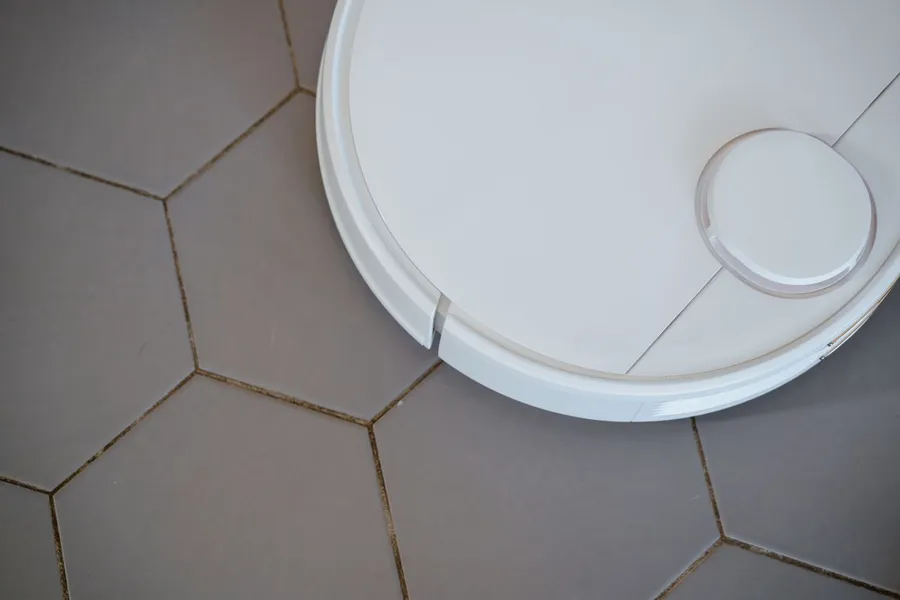
A price bracket exists today that simply did not two years ago: real laser navigation, saved maps and no-go zones, without a self-emptying base. The Lefant M330 Pro sits precisely there. It claims 5,000 Pa, navigates with a dToF laser sensor, dodges obstacles using 190-degree PSD sensors, and runs up to 150 minutes on a 2,600 mAh battery.
Its 450 ml bin is generous for the class. The pad that clips underneath should be understood for what it is: a damp pass that lifts the dust film, not a wash. Owners say as much in their reviews — on dried-on spills it does very little. In a two-room flat with hard floors, I would not spend a penny more than this.
 Illustrative image
- dToF laser navigation with multiple saved maps and no-go zones
- 190-degree PSD obstacle sensors
- Claimed runtime up to 150 minutes
- 9.5 cm tall, so low furniture stays reachable
| Suction | 5,000 Pa |
|---|---|
| Runtime | up to 150 min |
| Height | 9.5 cm |
| Dust bin | 450 ml |
| Mop system | clip-on pad, 200 ml tank |
| Technology | dToF laser + 190° PSD |
Laser navigation and saved maps at an entry-level price; at 9.5 cm tall it slides under furniture that docked models cannot reach.
The 200 ml water tank needs refilling constantly and a dragged pad does not wash; the app is rougher than Dreame's or Roborock's, and you empty the bin by hand every second or third run.
Does a self-emptying base actually change anything?
It does, though not for the reason most people assume. It is not about effort: emptying a 400 ml bin takes ten seconds. It is about the cloud of dust that comes back at you each time, and about how often. With a 4-litre bag in the dock, that chore becomes monthly, and anyone with a dust or pollen allergy notices the difference immediately.
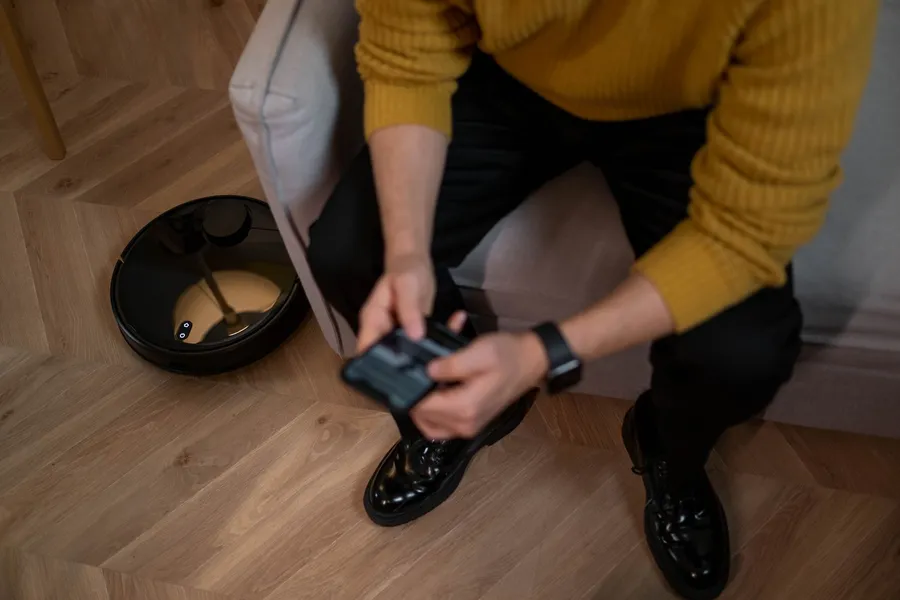
The Dreame D10 Plus Gen 2 is the model we would put in most homes: 6,000 Pa, LiDAR navigation with multi-floor mapping, a claimed 285 minutes of runtime from a 5,200 mAh pack, and automatic suction boost when it detects carpet. It stands 9.6 cm tall and weighs 3.23 kg. The dock empties in roughly ten seconds and it is loud while it does so; keep it in a hallway rather than a bedroom.
 Illustrative image
- Dock with a 4-litre bag and automatic emptying
- LiDAR navigation with multi-floor mapping
- Automatic suction boost on carpet
- Claimed runtime up to 285 minutes
| Suction | 6,000 Pa |
|---|---|
| Runtime | up to 285 min |
| Height | 9.6 cm |
| Dust bin | 400 ml |
| Mop system | removable pad, 3 water levels |
| Technology | LiDAR + multi-floor maps |
One of the longest claimed runtimes in its class, paired with a 4-litre bag that turns maintenance into a monthly job.
The mop pad still gets washed in your sink, as on any robot without a water station; replacement bags are a recurring cost, and the emptying burst is genuinely irritating in a studio flat.
Mopping: dragging a damp cloth is not washing
This is where half the market quietly cheats. A damp pad dragged behind the robot collects fine dust and leaves the floor wet. Two discs spinning at 200 rpm, lifting 10 mm when they meet carpet and rinsing themselves back at the dock, are a different tool entirely. The Roborock Qrevo S belongs to the second group.
It claims 7,000 Pa, navigates with PreciSense LiDAR plus structured light for obstacles, holds 330 ml in the bin and comes with a dock that empties, washes and hot-air dries the pads, the drying cycle running at around 45 dB. The number I find most useful is a different one: 9.65 cm of height, so low furniture is still fair game. The catch is familiar — after a couple of months, owners with long hair at home report reaching for scissors around the side brushes anyway.
 Illustrative image
- Twin rotating pads with a 10 mm lift over carpet
- Dock that empties, washes the pads and hot-air dries them
- PreciSense LiDAR plus structured-light obstacle avoidance
- 9.65 cm tall despite the full dock
| Suction | 7,000 Pa |
|---|---|
| Runtime | up to 180 min |
| Height | 9.65 cm |
| Dust bin | 330 ml |
| Mop system | twin rotating pads 200 rpm, 10 mm lift |
| Technology | PreciSense LiDAR + structured light |
Twin rotating pads that lift automatically over carpet: this is the feature that separates a robot that washes from one that dampens.
The dock eats floor space and needs a level spot near a socket; genuine spares start around 10-20 euros a piece, which is why most owners end up buying a 50-80 euro kit.
Cat hair, long hair and brushes that knot up
Six-month reviews almost always circle the same complaint. Not power — hair wound tight around the main brush, and worse, around the side brushes. Serious fixes exist under various trade names, ECOVACS calling its comb-based version ZeroTangle: the hair gets cut before it can wrap.
The ECOVACS Deebot T30 Pro Omni is the best-equipped machine in this selection: a claimed 11,000 Pa, LDS navigation, a 5,200 mAh battery good for roughly 200 minutes, mop washing with 70°C water and a 9 mm lift over carpet. The mini station is noticeably more compact than the previous generation and tucks under many kitchen counters. The trade-off is noise: published measurements put it between 59 and 72 dB depending on mode, with a stated 65 dB peak in normal vacuuming. I would not set it running while someone is on a call in the next room.
 Illustrative image
- Pad washing with 70 °C water in the mini station
- ZeroTangle comb system against wrapped hair
- Claimed 11,000 Pa and a 9 mm lift over carpet
- Station roughly 30% smaller than the previous generation
| Suction | 11,000 Pa |
|---|---|
| Runtime | about 200 min |
| Height | 10.4 cm |
| Dust bin | 300 ml |
| Mop system | twin rotating pads, 70 °C wash, 9 mm lift |
| Technology | LDS navigation + ZeroTangle |
Hot-water pad washing and a genuine anti-tangle system: two features you notice six months in, not on day one.
It is the loudest and the tallest here at 10.4 cm, so some sofas are off limits, and the station still claims its own corner.
Nine and a half centimetres: the sofa decides
Get a tape measure. Check the clearance under the sofa, under the living-room unit and under the bed, then subtract half a centimetre for safety. That single number rules out half the robots on sale.
The four models here range from 9.5 to 10.4 cm, and the gap looks trivial until you find your sofa leaves exactly 10. In small flats the problem shifts to the dock, which occupies a square of floor and needs clear space in front of it — the same reasoning we applied when picking a small air fryer, where footprint matters as much as performance.
What it costs to keep running each year
| Consumable | How often | Note |
|---|---|---|
| HEPA filter | 3-6 months | Washable on most models, but loses efficiency |
| Side brush | 3-6 months | First part to bend out of shape |
| Microfibre pads | 6-12 months | Stiffen up in hard-water areas |
| Dock bags | 1-2 months | Self-emptying models only |
Nobody budgets for this line at checkout. Roborock owners report genuine parts starting around 10-20 euros each plus shipping, which pushes most people towards a full kit. Compatible alternatives exist and cost less, though on filters the saving tends to show up as weaker suction.
Before ordering, search for the spare-parts kit for the exact model and check it is in stock. An excellent robot with unobtainable spares lasts two years, not six.
When it is worth buying
The worst day to buy a robot vacuum is an ordinary day in September. Fully docked models drop noticeably during the two big promotional windows at the end of the year, and the mid-range moves in spring as well, when new generations arrive and the previous ones stay on the price list.
If you need one now — a house move, a dog that has just started shedding, an allergy diagnosed last week — buying today is perfectly rational. Last year's docked model cleans better than the new model you are waiting for in November.
Do not buy one if…
If deep-pile rugs cover most of your rooms, a robot is the wrong tool: it climbs, sinks in and collects a fraction of what a cordless stick would. If you live over two floors with internal stairs, remember you will be carrying it up and down, and at that point a stick vacuum makes more sense.
And if your actual problem is crumbs under the dining table after dinner, a dustpan costs nothing and takes two minutes.
| Lefant M330 Pro robot aspirapolvere e lavapavimenti 5000 Pa | Dreame D10 Plus Gen 2 robot aspirapolvere con svuotamento automatico | Roborock Qrevo S robot aspirapolvere e lavapavimenti con stazione | ECOVACS Deebot T30 Pro Omni robot aspirapolvere e lavapavimenti | |
|---|---|---|---|---|
| Best for | For hard floors on a tight budget | For most homes | For floors you want genuinely washed | For pet homes with no time for upkeep |
| Suction | 5,000 Pa | 6,000 Pa | 7,000 Pa | 11,000 Pa |
| Runtime | up to 150 min | up to 285 min | up to 180 min | about 200 min |
| Height | 9.5 cm | 9.6 cm | 9.65 cm | 10.4 cm |
| Dust bin | 450 ml | 400 ml | 330 ml | 300 ml |
| Mop system | clip-on pad, 200 ml tank | removable pad, 3 water levels | twin rotating pads 200 rpm, 10 mm lift | twin rotating pads, 70 °C wash, 9 mm lift |
| Technology | dToF laser + 190° PSD | LiDAR + multi-floor maps | PreciSense LiDAR + structured light | LDS navigation + ZeroTangle |
| Base station | none, charging only | auto-empty, 4 L bag | auto-empty, pad washing and drying | mini station: empties, hot-washes and dries |
| Price band | Budget pick | – | – | – |
| See on Amazon | Search on | Search on | Search on |
Our verdict
Spending as little as possible on hard floors: the Lefant M330 Pro, knowing the pad dampens rather than washes. Looking for the best balance of price, runtime and upkeep, which is what we would put in most homes: the Dreame D10 Plus Gen 2. Want the floor genuinely washed and have room for the dock: the Roborock Qrevo S. Two cats, long hair and no appetite for maintenance: the ECOVACS Deebot T30 Pro Omni, noise accepted.
Check today's price on Amazon Paid link
Frequently asked questions
How much suction does a robot vacuum really need?
Does a robot vacuum handle dog and cat hair?
Robot vacuum or cordless stick vacuum?
Do you need Wi-Fi to use a robot vacuum?
Can a mopping robot replace a mop and bucket?
How long does a robot vacuum battery last?
As an Amazon Associate I earn from qualifying purchases.

Emily Carter
Editorial byline of the English edition for home, kitchen and beauty. Angle: what verified reviews say happens after a month of use, and the cheap products that surprise.
Guide produced by the editorial team with AI tools from verified sources and published under the editorial responsibility of Andrea Bertolotti. How we work · Report an error
You may also like
Coffee machines: which to buy and what to actually spend
Capsules, portafilter or beans: how cost per cup really works, how much counter space you need, and four coffee machines picked for different homes.
Small compact air fryer: 4 picks for 1-2 people
From 2 to 4 quarts: the real countertop footprint in inches, what clears your upper cabinets, and how much food actually fits in a single layer.
Air fryer buying guide: right size, watts and three models worth buying
Litres, watts, temperature and running costs explained without the hype: what actually matters when choosing an air fryer, and the three models we would buy for singles, couples and families.
The best guides, once a week
No spam: only products worth knowing about and deals that make sense.