Best Kids Headphones for School: Durable, Volume-Limited Picks
Three kids headphones capped at 85 dB, picked for school, home and travel: which ones survive the backpack, and when a cable matters more than Bluetooth.
In this article
For a kid who takes headphones to school and uses them at home too, the kids headphones to buy are the Belkin SoundForm Mini: volume capped at 85 dB, Bluetooth plus an included cable for when the battery dies, and a build meant to survive backpacks and lunchboxes. If your kid flies often or studies somewhere loud, it's worth stepping up to the JBL Junior 470NC, with noise cancellation and parental controls from your phone.
- For school and home Belkin SoundForm Mini cuffie wireless per bambini Budget pick See on Amazon
- For little kids at home JBL JR310BT cuffie wireless per bambini Budget pick See on Amazon
- For travel and loud places JBL Junior 470NC cuffie per bambini con cancellazione del rumore Premium See on Amazon
How we chose
We started with the best-selling volume limiting headphones on Amazon.com and cut any pair that doesn't publish a decibel cap, or publishes one in fuzzy terms. What was left came from brands with full spec sheets and U.S. customer support. For each model we cross-checked the manufacturer's specs against measurements and reviews from SoundGuys, HeadphonesAddict and Popular Science, and against verified buyer reviews written after a few months of use, which is where broken hinges, flaking ear pads and tired batteries show up. We don't physically test products in-house: when we say a pair holds up, that's based on these sources.
Our criteria, in order of weight: a stated volume limit the child can't override, durability, the option to go wired, a microphone that works for class, and comfort on small heads. Price came last. The spread in this category is narrow, and a pair that snaps in February ends up costing more than one that lasts until June.
The three pairs we recommend
 Illustrative image
- Volume capped at 85 dB
- Bluetooth plus included 3.5 mm cable
- Up to 30 hours of battery life
- Built-in mic, stickers, 2-year warranty
| Type | On-ear |
|---|---|
| Connectivity | Bluetooth + 3.5 mm cable |
| Battery life | 30 hrs |
| Microphone | Built-in |
| Noise cancelling | No |
| Functions | 85 dB cap |
The SoundForm Mini is the pair we'd hand to most families. The limiter is fixed at 85 dB, the buttons are big enough for a kid to find without looking, and the box includes a 3.5 mm cable: when the battery runs out mid-lesson, plug in and keep going. Belkin lists 30 hours of battery life, a built-in mic for video calls and factory durability testing of 3,000 uses plus spills. That's the manufacturer's claim, not our measurement, but it's the only one in this group put in writing, alongside a two-year warranty.
- Works over Bluetooth or with the cable, so a dead battery doesn't end the lesson
- 85 dB cap built in, with no settings to remember
- Stickers in the box make it easy to spot your kid's pair in a classroom bin
- On-ear cushions: after an hour some kids find them warm
- The built-in mic is fine for a call, weaker in a noisy classroom
- The headband can feel snug past age 12
Who it's for: kids from about 4 to 10 who use the same headphones at school and on the couch, and parents who don't want to buy two pairs.
 Illustrative image
- Volume stays under 85 dB
- About 115 g, the lightest pick
- 30 hours; 5-minute charge = 2 hours
- Bluetooth only, built-in mic
| Type | On-ear |
|---|---|
| Connectivity | Bluetooth only |
| Battery life | 30 hrs |
| Microphone | Built-in |
| Noise cancelling | No |
| Functions | 85 dB cap |
At around 115 grams according to JBL, the JR310BT is the lightest pair here, and that matters on a six-year-old's head. Volume also tops out at 85 dB, rated battery life is 30 hours, and five minutes on USB-C gives about two hours of listening. The sound is full for the price, without bloated bass. The catch: there's no wired mode at all, so once the battery hits zero, the headphones are done until they're charged.
- The smallest and lightest pick, a good fit for little kids
- Fast USB-C charging, handy on a rushed school morning
- Built-in mic and customizable stickers
- Bluetooth only: no audio cable, no backup plan
- Small sizing that most kids outgrow around 10 or 11
- No case included
Who it's for: kids ages 3 to 7 who mostly listen at home, with a tablet that stays charged.
 Illustrative image
- Active noise cancellation
- App parental controls for volume and time
- Up to 50 hours (34 with ANC)
- Over-ear, Bluetooth 5.3, 196 g
| Type | Over-ear |
|---|---|
| Connectivity | Bluetooth 5.3 |
| Battery life | 50 hrs (34 with ANC) |
| Microphone | Built-in |
| Noise cancelling | Yes |
| Functions | 85 dB + app limits |
Moving up, the Junior 470NC raises the bar. It's over-ear, so the cups surround the ear instead of pressing on it, and it has active noise cancellation: on a plane, a school bus or in a crowded waiting room, a kid doesn't need to crank the volume to hear. JBL rates it at up to 50 hours with ANC off and 34 with it on, Bluetooth 5.3, and 196 grams. The part parents care about is the JBL Headphones app, which can lower the cap below 85 dB, set a daily listening limit and show a weekly summary.
- Noise cancellation removes the urge to turn it up
- App-based parental controls for max volume and listening time
- Long battery life for road trips and flights
- The highest price tier in this group
- Bulkier and heavier, so it eats space in a school backpack
- The best features need a parent's phone
Who it's for: kids 8 and up who travel, study somewhere loud, or have outgrown little-kid headphones.
For high schoolers who study in noisy places the question changes: that is where noise cancelling earbuds come in, and we compare them with over-ear headphones in a separate guide.
| Belkin SoundForm Mini cuffie wireless per bambini | JBL JR310BT cuffie wireless per bambini | JBL Junior 470NC cuffie per bambini con cancellazione del rumore | |
|---|---|---|---|
| Best for | For school and home | For little kids at home | For travel and loud places |
| Type | On-ear | On-ear | Over-ear |
| Connectivity | Bluetooth + 3.5 mm cable | Bluetooth only | Bluetooth 5.3 |
| Battery life | 30 hrs | 30 hrs | 50 hrs (34 with ANC) |
| Microphone | Built-in | Built-in | Built-in |
| Noise cancelling | No | No | Yes |
| Functions | 85 dB cap | 85 dB cap | 85 dB + app limits |
| Price band | Budget pick | Budget pick | Premium |
| See on Amazon | See on Amazon | See on Amazon |
What a volume limiter does and doesn't do
All three claim an 85 dB ceiling, the most common figure among kids headphones makers. For context, the WHO-ITU H.870 safe listening standard from 2019 uses an average of 75 dB over 40 hours a week as the reference for more sensitive listeners, children included. So the limiter trims dangerous peaks, yet it doesn't make unlimited listening safe: time matters too.
Two practical notes. The cap is measured by the manufacturer with a test signal, and with other sources the real level can drift by a few decibels, as HeadphonesAddict's published measurements of several kids models show. That's why it's worth setting a limit on the device as well: on iPhone and iPad it's under Settings, Sounds & Haptics, Headphone Safety; Android phones and Amazon Fire Kids tablets have a similar option in parental controls. The second note is about noise cancellation. It doesn't lower the volume by itself; it removes the reason a kid turns it up.
If the headphones will also be used with the family tablet, set the device's max volume once: it then covers a sibling's pair that has no limiter of its own.
Durability: where kids headphones actually break
Read the one-star reviews written six months in and the failures cluster in three spots. First, the hinge or headband, which gives way when the headphones are wrenched open or crushed in a backpack; look for flexible headbands without thin metal parts. Second, the cable, especially near the plug, which is why a detachable cord like the SoundForm Mini's adds real life. Third, faux-leather ear pads, which crack with sweat: check whether the maker sells replacements or whether compatible pads are easy to find.
There's a fourth issue no spec sheet mentions: hygiene. In class, headphones get passed around, and faux-leather pads wipe clean in seconds, while fabric ones soak up sweat and are harder to keep fresh. If the school asks for personal headphones, keep them personal and stored in their case.
A case or a pouch, even a cheap one, does more than any material. Headphones that ride loose between textbooks are the ones that come home at Thanksgiving with a cup dangling. Kids who also use a desk setup at home will get more out of our guide to the best monitor for kids, which covers ports and cables too.
Wired or Bluetooth: let the classroom decide
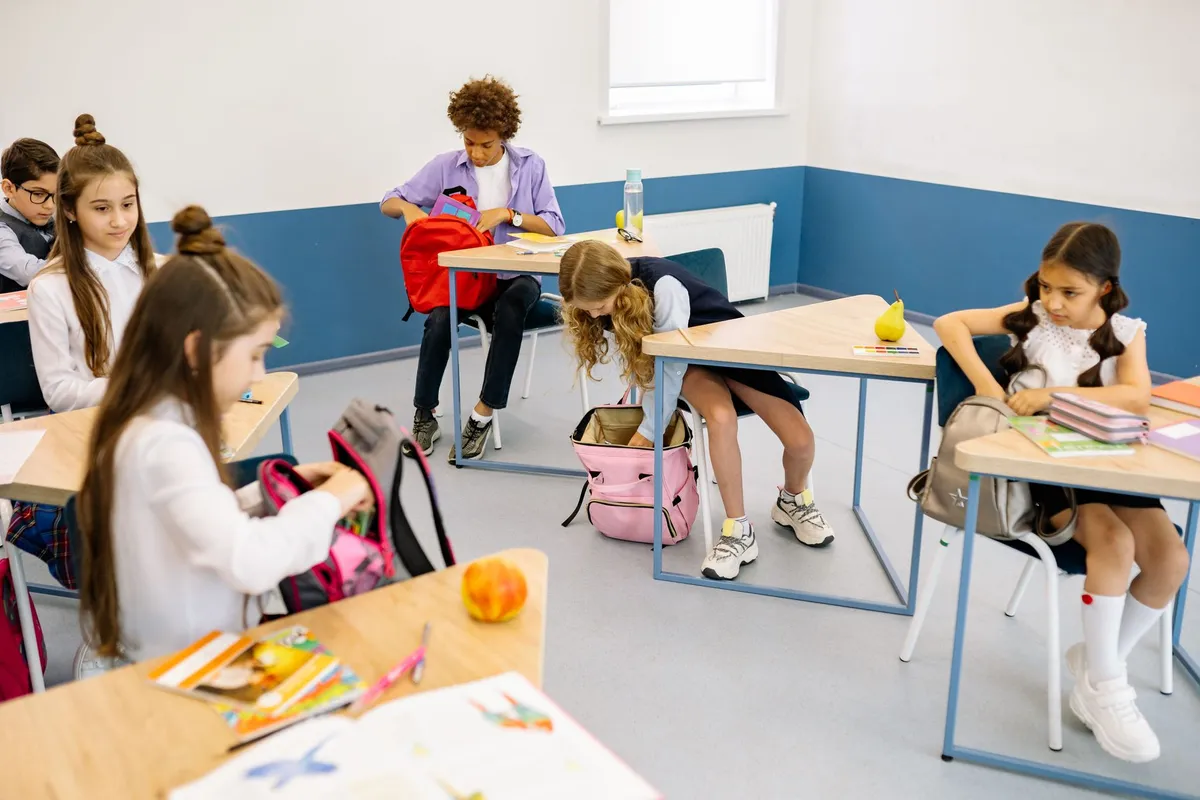
At home, Bluetooth wins: no cords underfoot, no bent plugs. School is different. Many U.S. districts run on shared Chromebooks or iPads, and pairing thirty sets of Bluetooth headphones to thirty devices is not how any teacher wants to start a lesson. That's why so many supply lists ask for wired headphones with a mic. Before you buy, check the list or ask the teacher.
If you don't know yet, the safest middle ground is a pair that does both, like the SoundForm Mini. If the school specifically asks for a boom mic for reading assessments, none of these three has one: look for classroom headsets with a boom mic and a volume cap stated in decibels. One caveat: if the school device only has USB-C, you'll need a USB-C to 3.5 mm adapter, and not every cheap one passes the mic signal.
Sizing by age: on-ear or over-ear
Every pair of kids headphones is sized for a range, not a single age, and the headband is usually the first thing to run out. On-ear pairs like the JR310BT and SoundForm Mini sit on the ear, weigh less and suit preschool and early elementary heads. Over-ear models like the Junior 470NC close around the ear, block more noise and fit better from about third grade up. A quick check at home: with the headband at its shortest setting, the cups should still press lightly on the ears; at the longest, there should be a couple of notches to spare for next year.
When to buy, and when to skip it
Back-to-school season and sales events like Prime Big Deal Days are when big-brand kids models most often go on promotion. Skip kids headphones altogether if your child is 13 or 14 and studies for long stretches somewhere loud: at that point a regular pair of ANC headphones, with the volume capped on the phone, makes more sense. And don't treat any of these as a substitute for breaks; no limiter replaces a few quiet hours.
Our verdict
If the headphones go to school and stay in use at home: Belkin SoundForm Mini, because the included cable turns a dead battery into a non-issue.
If your kid is little and listens mostly at home: JBL JR310BT, the lightest pair, with fast charging.
If your kid travels or studies somewhere loud: JBL Junior 470NC, with noise cancellation and limits you set from the app.
See it on Amazon.com Paid link
Frequently asked questions
What age are kids headphones for?
Is 85 dB a safe volume for kids?
Are headphones or earbuds better for kids?
Do Bluetooth headphones work with school Chromebooks?
How do you clean headphones used at school?
As an Amazon Associate I earn from qualifying purchases.

James Whitaker
Editorial byline of the English edition for gadgets, audio and smart home. Angle: distrust superlatives and explain specs in plain words without losing sight of the price.
Guide produced by the editorial team with AI tools from verified sources and published under the editorial responsibility of Andrea Bertolotti. How we work · Report an error
You may also like
Best Monitor for Kids: Eye-Friendly Picks for Homework
Four 24-inch monitors for kids' homework and remote classes, with adjustable stands, flicker-free screens and the right ports for PCs, Chromebooks and consoles.

AI smart glasses: which to buy and what they actually do
Ray-Ban Meta Gen 2, Oakley Meta HSTN and the new Oakley Meta Vanguard compared: what the AI does, real battery life, prescription options and privacy.

Earbuds or over-ear headphones: which ANC pair to buy for studying
Earbuds or over-ear headphones with noise cancelling? Isolation, battery life and comfort compared across four models sold in the U.S., with a pick for each profile.
The best guides, once a week
No spam: only products worth knowing about and deals that make sense.