Coffee machines: which to buy and what to actually spend
Capsules, portafilter or beans: how cost per cup really works, how much counter space you need, and four coffee machines picked for different homes.
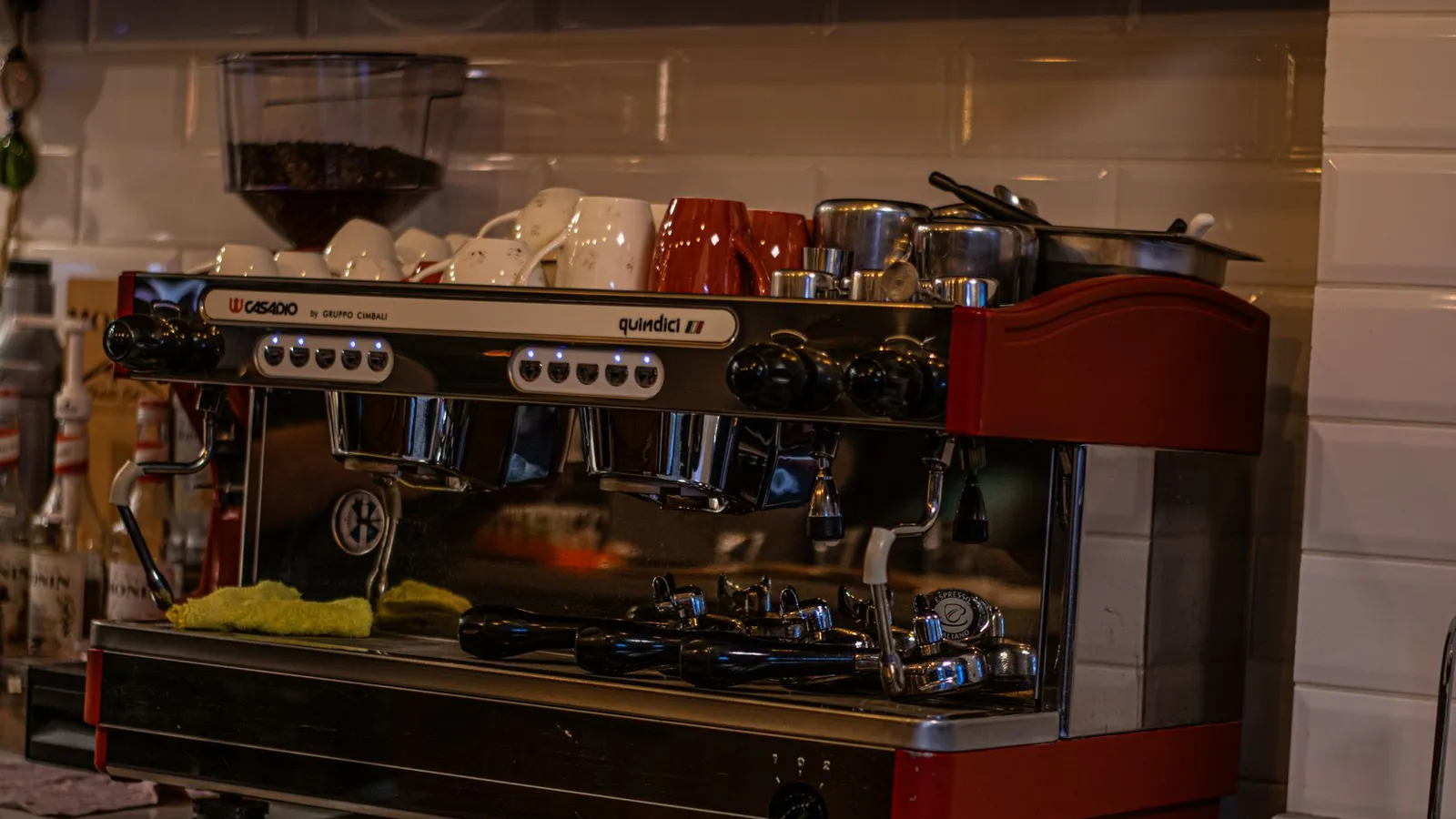
In this article
- How we picked
- Counter space is the spec people forget
- Capsules, pods or beans: what actually changes
- The cost-per-cup maths nobody does in the shop
- The 51 mm portafilter and the urge to learn
- What 19 bar really tells you
- Steel or ceramic burrs, and how many grind settings you need
- Milk: steam wand, carafe, or skip it
- Descaling, filters and the parts that wear out
- Our other kitchen buying guides
- When to buy
- Don't buy one if…
- Our verdict
"How much should I actually spend on a coffee machine?" is the wrong first question. Start here instead: a Nespresso Original capsule holds about 5 g of coffee, while a kilo of beans at 7 g a shot gives you roughly 140 espressos. Whichever of those two numbers fits your morning decides the machine, and everything else is detail.
- For a two or three person household De'Longhi Magnifica Evo ECAM290.21.B macchina automatica con macinacaffè Search on Amazon.com
- For one or two coffees a day Krups Nespresso Essenza Mini XN1101 macchina a capsule 0,6 L Budget pick See on Amazon
- For learning espresso with a portafilter De'Longhi Dedica Style EC685.M macchina espresso manuale 15 bar Mid-range See on Amazon
- For cappuccino every morning Philips Serie 3200 LatteGo EP3246/70 macchina automatica con caraffa latte Search on Amazon.com
How we picked
We don't run appliances through a lab, and we never write as though we had. Four sources do the work instead: manufacturer spec sheets, the user manuals (far more honest than any product page, because they list spare parts and service intervals), published lab work from consumer organisations such as Altroconsumo and OCU, and verified owner reviews written six months or more after purchase.
Three things carry weight. Cost per cup, which over a decade almost always exceeds the price of the machine. Maintenance you can actually do at home: descaling, filters, and whether the brew group slides out or is sealed inside. Counter space, which is the single most common reason a machine ends up in a cupboard by March. It's the same lens we use on the air fryer, where capacity beats wattage every time.
Bar figures, wattage and the number of "drinks" printed on the box carry none. They're the three specs marketing loves and the three that tell you least about what lands in the cup.
Counter space is the spec people forget
Measure the height first. A bean-to-cup machine stands 36 to 44 cm tall and the bean hopper lid opens upwards, so under a wall unit mounted 45 cm above the worktop it fits but you can't fill it without dragging it out. That complaint turns up in owner reviews for every brand, which tells you it's a design constraint rather than a bad batch.
| Machine type | Typical width | Typical height | Clearance needed above |
|---|---|---|---|
| Compact capsule | 8-15 cm | 20-25 cm | Very little: the tank sits behind |
| Slimline portafilter | 15 cm | 30-33 cm | Yes, to lift the tank out |
| Bean-to-cup | 24-26 cm | 36-44 cm | Yes, about 10 cm for beans |
Depth rarely bites, since almost everything sits within 44 cm and a standard worktop gives you 60. The socket does bite. Power cables on these machines are short, and an extension lead trailing under something that boils water is a bad habit to start.
Capsules, pods or beans: what actually changes
Capsules sell convenience, and they sell it honestly. One button, twenty-five seconds, a repeatable shot, no mess on the counter. The coffee inside was ground months ago and sealed well, which is not the same as fresh, and anyone who has lived with a grinder notices it in the first mouthful.
E.S.E. pods are the forgotten middle: 7 g of coffee pressed into filter paper, compostable, no aluminium to sort. The catch is availability, because supermarkets stock them patchily outside Italy.
Beans are the only route to aromas a capsule cannot hold onto. They come with a condition almost nobody factors in at the shop: an opened bag wants using within two or three weeks, otherwise you've bought fresh coffee and are drinking stale coffee.
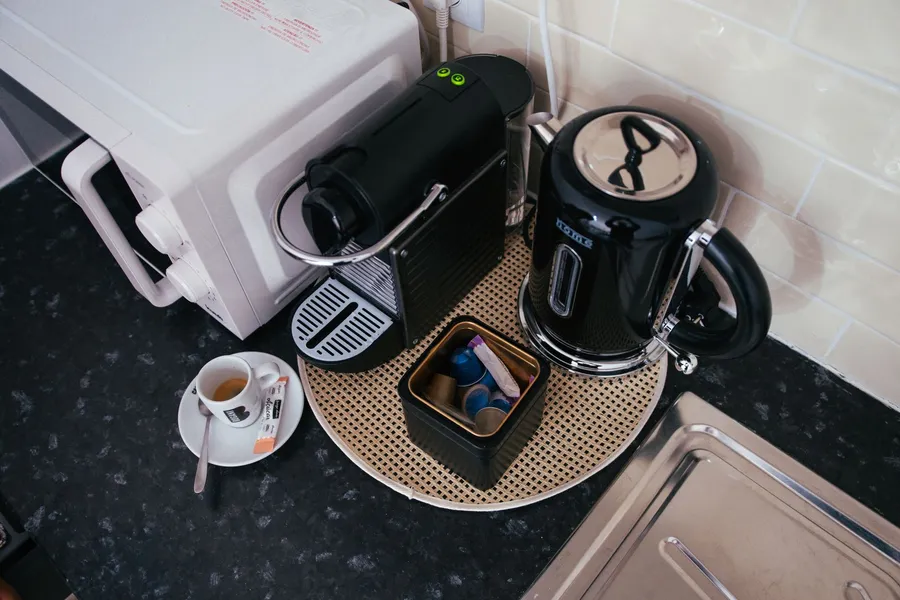 Illustrative image
- 8.4 cm wide, fits gaps nothing else will
- 25-second heat-up quoted by Krups
- Two programmable cup lengths
- Powers down on its own after nine minutes
| Type | Nespresso Original capsules |
|---|---|
| Pressure | 19 bar |
| Tank | 0.6 L |
| Power | 1310 W |
| Dimensions | 8.4 × 33 × 20.4 cm |
| Weight | 2.3 kg |
- At 8.4 cm wide it stands in gaps no other machine fits, which matters in a small rented kitchen.
- Krups quotes a 25-second heat-up and it powers down on its own after nine minutes.
- Two programmable cup lengths, set by holding a button rather than digging through a menu.
- No milk system at all, so cappuccino means buying a separate frother and finding space for it.
- The 0.6-litre tank needs refilling every other day if the household drinks four or five cups.
- You're locked into Nespresso Original or compatible capsules, and cost per cup never drops to bean level.
For one person drinking two espressos a day this machine is refreshingly honest about what it is. I'd happily put one in an office kitchen, where nobody wants to be the person responsible for descaling.
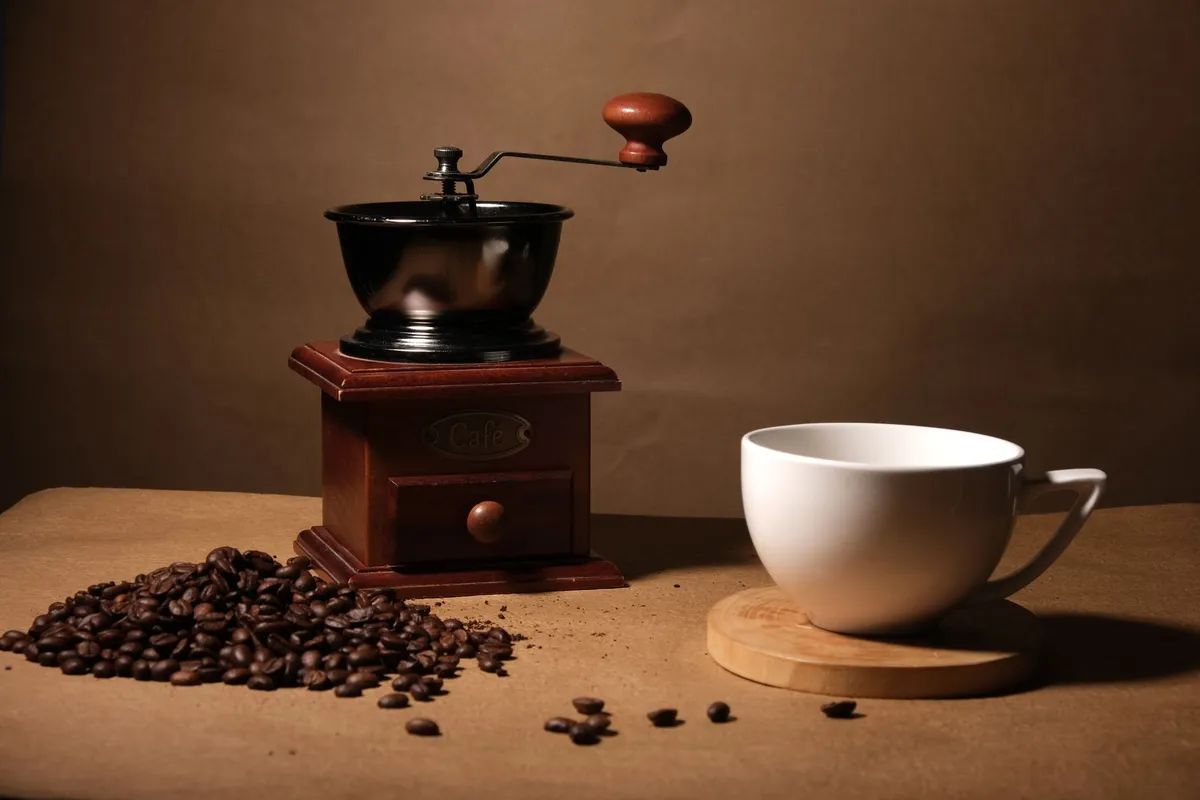
The cost-per-cup maths nobody does in the shop
Do this before you compare anything else. Take the capsule pack you normally buy, divide the price by the number of capsules, and that's your cup. Then take a kilo bag of beans and divide by 140, which is what 7 g shots give you.
The gap per cup looks trivial. Multiply it by three coffees a day across five years and it becomes the sum that pays for a bean-to-cup machine, a grinder, and a decent amount of good coffee on top. That's why a four-figure super-auto isn't automatically an indulgence: it depends entirely on volume.
Run the same sum for one coffee a day and it flips. Capsules win outright, and paying for an integrated grinder that fires once every twenty-four hours makes no sense. The principle is the one we apply to consumables in our robot vacuum guide: the sticker price is only the first instalment.
The 51 mm portafilter and the urge to learn
Some people find an automatic machine boring. They want to weigh the dose, tamp it, watch first drops at six seconds and adjust the grind tomorrow. For them, a portafilter machine under about £200 is the cheapest door into the hobby.
Here's the catch, and no product page states it plainly. The baskets in the box are pressurised: a calibrated hole builds crema even when the grind is wrong. That means the machine forgives beginners, and equally that real extraction control only arrives once you buy non-pressurised baskets. The portafilter is 51 mm rather than the industry-standard 58 mm, so the aftermarket shelf is a short one.
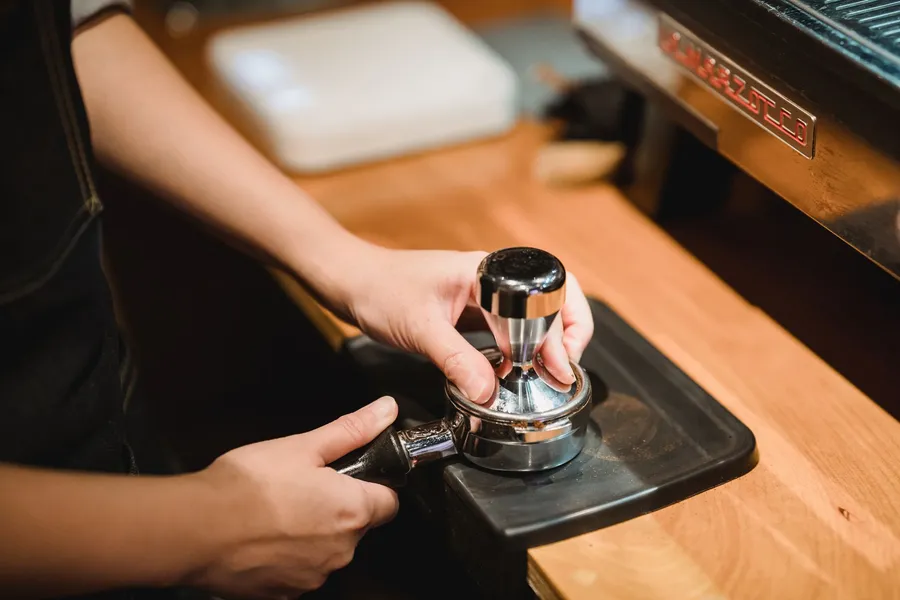 Illustrative image
- 51 mm portafilter in a 15 cm wide body
- Thermoblock ready in about 40 seconds
- Ground coffee or E.S.E. pods
- 1-litre removable tank
| Type | ground coffee or E.S.E. pods |
|---|---|
| Pressure | 15 bar |
| Tank | 1 L |
| Power | 1350 W |
| Dimensions | 15 × 33 × 30.5 cm |
| Weight | 4.2 kg |
- Fifteen centimetres wide for a machine with a genuine portafilter, which is the whole reason this model has lasted so long.
- Thermoblock ready in roughly 40 seconds, with a 1-litre removable tank.
- Takes ground coffee and E.S.E. pods, so you can switch between the two without buying anything else.
- The frother is a panarello: thick cappuccino foam, not latte-art microfoam, and reviewers have said so for years.
- Steam power handles one milk jug comfortably and two with a wait, so it's the wrong machine for four flat whites in a row.
- Without a separate grinder you're tied to pre-ground coffee, which undoes half the point of owning a portafilter.
My honest view: buy this only if a grinder is going in the basket too, or is already on the counter. Fed supermarket pre-ground, it produces a shot marginally better than a capsule, and at that point the capsule machine was the smarter purchase.
What 19 bar really tells you
Nineteen bar is not better than fifteen. Espresso extracts at around nine bar at the puck, and everything above that exists so the pump can overcome resistance in the system. Manufacturers quote peak pump pressure because it's a big number. A well-dialled 15-bar machine beats a 19-bar one with the wrong grind, every single time.
Wattage is nearly as empty. It governs how fast the machine reaches temperature, not how good the coffee is: a 1350 W thermoblock and a 1500 W super-auto heat up in broadly similar time because they're heating different masses of water.
The number worth reading barely appears in advertising: brew group dose range and bean hopper size. Six to fourteen grams per brew, as on the Magnifica Evo, means you can ask for a short dense shot or a long cup without the machine simply pushing more water through the same dose.
Drink counts matter less than they look, and only for milk. A machine with four recipes and a manual steam wand does everything a twenty-recipe model does, provided you're willing to froth milk yourself.
Steel or ceramic burrs, and how many grind settings you need
Steel conical burrs cut cleanly and tend to give a fuller cup. They also wear faster. Ceramic burrs heat the coffee less and last longer, with Philips quoting around 20,000 cups for the grinder in its 3200 series, which at three cups a day is a very long time.
Grind settings are oversold. Thirteen steps on the De'Longhi or twelve on the Philips are generous for anyone buying supermarket beans: you'll live on three or four settings in the middle and only move when switching between a light and a dark roast.
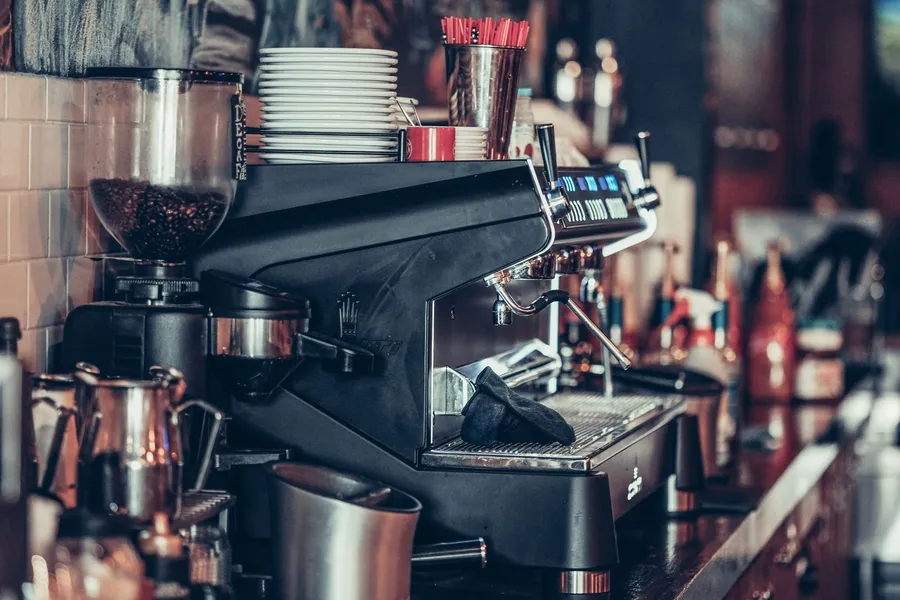 Illustrative image
- Steel conical burrs with 13 grind settings
- 250 g bean hopper
- Removable brew group dosing 6 to 14 g
- 1.8 L tank and 14-puck grounds bin
| Type | beans or pre-ground, built-in grinder |
|---|---|
| Pressure | 15 bar |
| Tank | 1.8 L |
| Power | 1450 W |
| Dimensions | 24 × 44 × 36 cm |
| Weight | 9.4 kg |
- Steel conical burrs, 13 grind settings, a 250 g hopper and a removable brew group that doses 6 to 14 g.
- A 1.8-litre tank and a 14-puck grounds bin, so it's a twice-weekly chore rather than a daily one.
- The brew group slides out and rinses under the tap, which is the difference between a machine that lasts eight years and one that gets binned.
- The grinder is loud, and owners say it carries through the flat at six in the morning.
- The bean hopper has no airtight seal, so an open bag still needs drinking quickly.
- Milk is manual: cappuccino yes, but with a jug in your hand and a minute of work.
- In six-month reviews the recurring complaint is watery coffee, nearly always traced to a grind set too coarse or a skipped descale.
This is the machine I'd recommend to the most people: households that drink espresso and long black through the day, want a cappuccino at the weekend, and would rather not pay for an automatic milk system they'd have to wash every night.
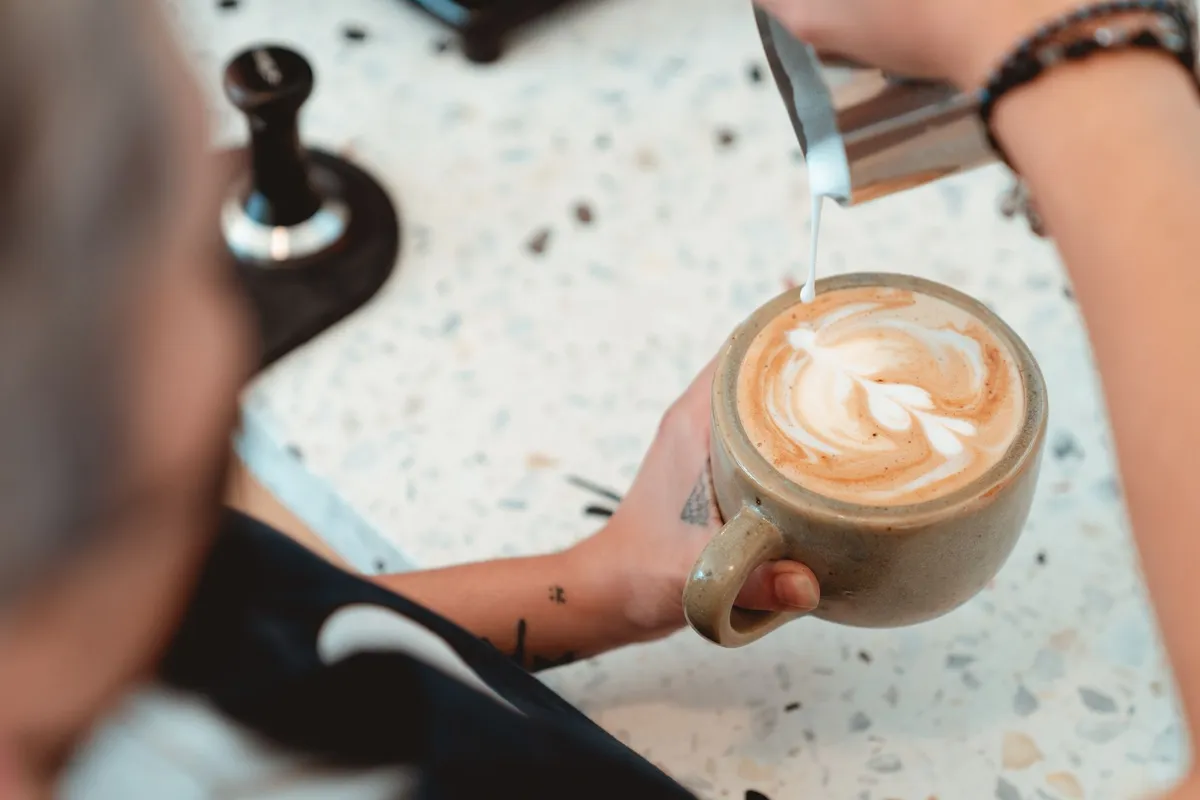
Milk: steam wand, carafe, or skip it
The milk system decides whether a machine gets used. A manual wand is cheap, stays clean and asks for thirty seconds plus a little technique. An automatic carafe delivers cappuccino at the touch of a button and needs washing daily, so if washing is a faff, milk drinks quietly disappear from the routine within a fortnight.
Philips got one thing genuinely right with LatteGo: two parts, no tubes, rinsed in about fifteen seconds. Anyone who has owned a carafe with a dip tube knows precisely why that matters.
 Illustrative image
- Two-piece LatteGo carafe with no tubes
- Ceramic burrs with 12 grind settings
- AquaClean filter: 5,000 cups quoted before descaling
- Five drinks from a touch display
| Type | beans or pre-ground, ceramic burrs |
|---|---|
| Pressure | 15 bar |
| Tank | 1.8 L |
| Power | 1500 W |
| Dimensions | 24.6 × 37.1 × 43.3 cm |
| Weight | 8 kg |
- Two-piece 0.26-litre LatteGo carafe with no internal tubing, dishwasher safe.
- Ceramic burrs with 12 settings plus the AquaClean filter: kept fitted, Philips quotes 5,000 cups before a descale is due.
- Five drinks from a touch display, with three selectable brew temperatures.
- AquaClean filters need replacing about every 50 tank fills, roughly quarterly, which is a running cost nobody budgets for.
- The 0.26-litre carafe covers two cappuccinos before a refill.
- On support forums the recurring issue with this series is a blocked dispensing spout when the rinse cycle after milk drinks gets skipped.
- At 43 cm tall, the bean lid won't open under a standard wall unit.
If cappuccino happens every morning in your house, this is the one, and the reason isn't the coffee. It's that a carafe you can rinse in fifteen seconds never gives you an excuse to skip it.
Descaling, filters and the parts that wear out
This is where machines that last part company with machines that die at four years old. Limescale is the main killer: super-autos want a cycle every two or three months in hard water, and skipping it narrows the water path until the coffee runs thin and pale.
A water filter rewrites that calendar. With AquaClean replaced on schedule, Philips pushes descaling out to 5,000 cups, though you should price the filters first, since they land three or four times a year. Without a filter, budget for descaler and an hour of patience every couple of months.
The second wear item is the brew group. Removable, as on both bean-to-cup machines here, means a rinse and an annual dab of food-safe grease. Sealed inside, as on plenty of premium machines, means a service centre and a bill. That's not a footnote; it's the difference between repairing and replacing.
Water hardness decides how often all of this happens, and most people never check it. A cheap test strip, or a call to the local water company, tells you whether you're on a two-month cycle or a five-month one. In hard-water areas a filter jug for the tank is the least glamorous upgrade you can make to a coffee machine, and probably the one that adds the most years to it. Soft-water households can relax: descale when the machine asks, and get on with your morning.
Generic descaling tablets are not interchangeable. Some machines only recognise liquid descaler cycles and stall halfway through the procedure. The manual says so; the marketing page almost never does.
Our other kitchen buying guides
This is the pillar guide for coffee machines, and the comparisons by price band and machine type will branch off from here. While that grows, these are the other kitchen guides worth a look.
For sizing, and for what the wattage really buys you, start with our air fryer guide.
One or two people with half a metre of free worktop will get more out of our small air fryer picks.
For floors that get done without you thinking about them, there's the robot vacuum guide, with and without mopping.
When to buy
Coffee machines follow a predictable calendar. New models from the big brands land between March and May, and last year's versions start sliding from September onwards. If you're not in a hurry, buy the previous generation in autumn: between a two-generation Magnifica Evo and the current one, the difference is the display, not the coffee.
The second window is late November, and we'll be blunt about it on our deals page when it goes up. Coffee machines are among the categories that move most in that period, partly because they're such a standard Christmas present. Buy in mid-December and you'll usually pay more than the person who bought at the end of November.
One practical habit worth keeping: when you see a bundle with a grinder or a bag of beans thrown in, price the two items separately. Bundles often cost the same as buying both, and the included coffee tends to be whatever the manufacturer struggles to shift.
Don't buy one if…
Don't buy a bean-to-cup machine if you drink one coffee a day. It rinses on start-up and rinses again on shut-down, so at that volume more water goes through the rinse cycle than through the coffee, and the tank empties without you having drunk anything.
Don't buy a portafilter machine unless a grinder is part of the plan, for the reasons above. Don't buy capsules if your stated goal is saving money, because convenience is what you're paying for and it isn't cheap. And don't buy any of the three if the only free spot in the kitchen is inside a closed cabinet: these machines want air above them and a tap nearby.
| De'Longhi Magnifica Evo ECAM290.21.B macchina automatica con macinacaffè | Krups Nespresso Essenza Mini XN1101 macchina a capsule 0,6 L | De'Longhi Dedica Style EC685.M macchina espresso manuale 15 bar | Philips Serie 3200 LatteGo EP3246/70 macchina automatica con caraffa latte | |
|---|---|---|---|---|
| Best for | For a two or three person household | For one or two coffees a day | For learning espresso with a portafilter | For cappuccino every morning |
| Type | beans or pre-ground, built-in grinder | Nespresso Original capsules | ground coffee or E.S.E. pods | beans or pre-ground, ceramic burrs |
| Pressure | 15 bar | 19 bar | 15 bar | 15 bar |
| Tank | 1.8 L | 0.6 L | 1 L | 1.8 L |
| Power | 1450 W | 1310 W | 1350 W | 1500 W |
| Dimensions | 24 × 44 × 36 cm | 8.4 × 33 × 20.4 cm | 15 × 33 × 30.5 cm | 24.6 × 37.1 × 43.3 cm |
| Weight | 9.4 kg | 2.3 kg | 4.2 kg | 8 kg |
| Milk system | manual steam wand | none | steam wand with panarello | automatic LatteGo carafe (0.26 L) |
| Price band | – | Budget pick | Mid-range | – |
| Search on | See on Amazon | See on Amazon | Search on |
Our verdict
One or two coffees a day, no space to spare: the Krups Essenza Mini. Cheap, tiny, essentially maintenance-free, and cappuccino will cost you a separate frother.
Learning espresso properly, grinder already in mind: the De'Longhi Dedica Style, accepting that the pressurised baskets want replacing before you get real control over extraction.
A two or three person household drinking coffee all day: the Magnifica Evo ECAM290.21.B is our pick. Steel burrs, removable brew group, and a manual wand for weekend cappuccinos.
Cappuccino every single morning: the Philips 3200 with the LatteGo carafe, budgeting for AquaClean filters four times a year and finding 43 cm of clearance on the counter.
Check today's price on Amazon Paid link
Frequently asked questions
Is a bean-to-cup coffee machine worth it?
How many bar do you need for espresso?
How often should you descale a coffee machine?
Why is my bean-to-cup coffee coming out watery?
Can you use pre-ground coffee in a bean-to-cup machine?
Do capsule machines make espresso as good as a café?
As an Amazon Associate I earn from qualifying purchases.

Emily Carter
Editorial byline of the English edition for home, kitchen and beauty. Angle: what verified reviews say happens after a month of use, and the cheap products that surprise.
Guide produced by the editorial team with AI tools from verified sources and published under the editorial responsibility of Andrea Bertolotti. How we work · Report an error
You may also like
Robot vacuums worth buying: four models and what matters
Four robot vacuums compared, from a dockless budget model to a hot-water washing flagship: height, pet hair, spare parts and how much work they actually save.
Small compact air fryer: 4 picks for 1-2 people
From 2 to 4 quarts: the real countertop footprint in inches, what clears your upper cabinets, and how much food actually fits in a single layer.
Air fryer buying guide: right size, watts and three models worth buying
Litres, watts, temperature and running costs explained without the hype: what actually matters when choosing an air fryer, and the three models we would buy for singles, couples and families.
The best guides, once a week
No spam: only products worth knowing about and deals that make sense.